Yesterday, on CNN International, a stock analyst was discussing Baidu.com the Chinese search engine. He was discussing competitive pressure and mentioned that in China the cost of a PC is a major expense. He said that the real trend in technology, and bridging the digital divide, was going to be in cell phones. He mentioned that Baidu.com did not have a clear cell phone strategy.(? what evey that is...)
Some thoughts.....
If a PDA is viewed as an extension of a cell phone then the idea of using PDAs to teach technology, the Kenya posting, makes sense. The integration of digital cameras into cell phones seems to be happening quickly.
I have owned Palm and Pocket PC's. I find them crucial and use it everyday. I can read and even create spreadsheets on my PDA, but I would never do that for any meaningful work. When ever I think of cell phones I think of the hassle of data entry. I have fiddled with text messaging, but it really is awkward, maybe just old hands and a stubborn brain. A PDA makes sense for data viewing and data consolidating, but for me, even with a keyboard, it does not seem useful for data creation.
People want to learn computers for employability, not necessarily for personal development.
I wonder if training is for data creation and whether data consuming is done without training.
The need for critical thinking, analysis, creativity, and the liberal arts tradition is necessary for both data creation and data consuming. (Maybe that is just elitism, when I watch TV, listen to some of the arguments on the news networks, or look at the magazines at the grocery checkout I wished that people had some awareness of critical thinking.)
Back to the original question, how do people, adults, learn computers skills and apply them in their daily lives?
Monday, August 08, 2005


Sunday, August 07, 2005
TagCloud - View Cloud
TagCloud - View Cloud
This is an experiment. TagCloud will look at an RSS Feed and will create a tag cloud. Pretty cool.
This is an experiment. TagCloud will look at an RSS Feed and will create a tag cloud. Pretty cool.
Saturday, August 06, 2005
Living with a mirror
Visiting and living in another culture is like living with a mirror. Experiencing another culture is a mirror into my own culture. Differences clarify more then similarities. By watching cell phone usage in Thailand I learn about cell phone usage in Alaska. By thinking about how people learn about technology in Thailand I learn more about how people learn to use technology in Alaska. By learning about and experiencing another culture I clarify my own cultural influences. When I came to Alaska in 1967 I lived in Shaktoolik for a year. That year changed my life and changed my values. Until 1984 my professional and personal experiences were cross-cultural. Learning about Thailand, experiencing Thailand, is another chance to learn more about myself and my culture. I am excited about the opportunity.
Learning to use a cell phone....
People do not take lessons to use a cell phone. Last time I was in Thailand the cell phone use was amazing. We were in an area, where many of Jit's relatives live, with very poor roads. People were using cell phones to arrange transportation and to make plans. Nobody took lessons, they just used the tools and adapted new ways to apply the tools. Very few people take lessons to learn to drive, they pick up the skill, or at least drive, maybe with limited skill. Maybe at certain levels computer use is the same way? Using email, searching, browsing, getting information, might not need training, just motivation and inspiration. Maybe the role of training is just to be a catalyst to start the using process. Maybe having an in depth computer user to watch, infects or inspires other users with the capability. As I explore I need to watch what is happening and not just watch for what I want to see. Last time I was in Thailand cell phones were everywhere, people at all economic levels and in all situations were using cell phones, the advantage of using cell phones was so clear that it had become a necessity.
Lessons can be like stairs or a ladder, they can allow you to go higher, but they might not be necessary for technology to be useful and valuable. Ladders help people who want to climb.
Instead of lessons, or classes, or instructions, maybe creating showcases of dynamic users is a more effective method to get people to adopt technology. If people see technology being useful they will adopt technology. Once people start climbing they can use lessons, but the motivation and the inspiration must precede the lessons. Like driving though, some people can function well without ever taking lessons.
These are not conclusions, just thoughts and questions for observation.
Lessons can be like stairs or a ladder, they can allow you to go higher, but they might not be necessary for technology to be useful and valuable. Ladders help people who want to climb.
Instead of lessons, or classes, or instructions, maybe creating showcases of dynamic users is a more effective method to get people to adopt technology. If people see technology being useful they will adopt technology. Once people start climbing they can use lessons, but the motivation and the inspiration must precede the lessons. Like driving though, some people can function well without ever taking lessons.
These are not conclusions, just thoughts and questions for observation.
Pilot program brings handhelds to Kenyan students - Engadget - www.engadget.com
Pilot program brings handhelds to Kenyan students - Engadget - www.engadget.com
Having used Pocket PC's and Palm devices I am pretty skeptical of this approach. To me Pocket PC's and Palm devices are peripherals to computers and do not take there place. Also the skills to use Pocket PC's are usually based on computer skills.
Having used Pocket PC's and Palm devices I am pretty skeptical of this approach. To me Pocket PC's and Palm devices are peripherals to computers and do not take there place. Also the skills to use Pocket PC's are usually based on computer skills.
BBC NEWS | South Asia | India launches its first cheap PC
BBC NEWS | South Asia | India launches its first cheap PC
Press Release from the manufacturer
I wonder how this compares to the Thailand People PC. Also the same issue of training remains. Computers without training are just furniture. There can be many methods of training, including good documentation, but I want to learn more details.
Press Release from the manufacturer
I wonder how this compares to the Thailand People PC. Also the same issue of training remains. Computers without training are just furniture. There can be many methods of training, including good documentation, but I want to learn more details.
Wednesday, August 03, 2005
LTN: Thai Linux Working Group
LTN: Thai Linux Working Group
Another Thai Linux link. I track both Thailand and Bangkok information by subscribing to de.licio.us links through Bloglines. Whenever a person tags a link with Thailand or Bangkok I am notified through Bloglines. Both services are free.
Another Thai Linux link. I track both Thailand and Bangkok information by subscribing to de.licio.us links through Bloglines. Whenever a person tags a link with Thailand or Bangkok I am notified through Bloglines. Both services are free.
ThaiLinuxcafe.com
ThaiLinuxcafe.com
An interesting link! The lack of Thai knowledge becomes glaringly obvious to me when I scan a web site like this. Looks like a good resource though.
An interesting link! The lack of Thai knowledge becomes glaringly obvious to me when I scan a web site like this. Looks like a good resource though.
The Jhai Foundation: Technology
The Jhai Foundation: Technology
This is an interesting resource. I found the link through the Wall Street Journal column "Engineers Modify High-Tech Devices For World's Poorest" by Lee Gomes. I wished I could Blog to Wall Street Journal articles, but you need a paid subscription. I do archive the information for my personal use using a free software program called EverNote. With EverNote I can copy any data and keep it in a file for later reference. It is a great way to gather information.
This is an interesting resource. I found the link through the Wall Street Journal column "Engineers Modify High-Tech Devices For World's Poorest" by Lee Gomes. I wished I could Blog to Wall Street Journal articles, but you need a paid subscription. I do archive the information for my personal use using a free software program called EverNote. With EverNote I can copy any data and keep it in a file for later reference. It is a great way to gather information.
Monday, August 01, 2005
Human Development Foundation
Human Development Foundation
The Human Development Foundation is the organization that is founded by Father Joe Maier.
The Human Development Foundation is the organization that is founded by Father Joe Maier.
Thaiwriter's Weblog - Klong Toey stories
Thaiwriter's Weblog - Klong Toey stories
In Thailand, beside the roads, beside the railroad tracks, and in other places people live. I have heard of Klong Toey, it is near where we get the boat to cross the river to Jit's house. I have also heard of Father Joe Maier and I would like to visit and see what he is doing. I read about a book, Fragile Days, in the Bangkok Post that is written by Tew Bunnag who volunteers with Father Maier. I have ordered the book from Singapore. In this context, and out of curiosity I am reading a book called Shadow Cities: A Billion Squatters, A New Urban World which argues, I think with justification, that urban slums are really energetic, and in some ways, healthy communities. The book describes squatter cities in Rio de Janeiro, Nairobi, Mumbai, and Istanbul. I have no idea how Klong Toey relates or supports the thesis in Shadow Cities, but I am curious. The Klong Teoy book is Welcome To The Bangkok Slaughterhouse: The Battle For Human Dignity In Bangkok's Bleakest Slums
In Thailand, beside the roads, beside the railroad tracks, and in other places people live. I have heard of Klong Toey, it is near where we get the boat to cross the river to Jit's house. I have also heard of Father Joe Maier and I would like to visit and see what he is doing. I read about a book, Fragile Days, in the Bangkok Post that is written by Tew Bunnag who volunteers with Father Maier. I have ordered the book from Singapore. In this context, and out of curiosity I am reading a book called Shadow Cities: A Billion Squatters, A New Urban World which argues, I think with justification, that urban slums are really energetic, and in some ways, healthy communities. The book describes squatter cities in Rio de Janeiro, Nairobi, Mumbai, and Istanbul. I have no idea how Klong Toey relates or supports the thesis in Shadow Cities, but I am curious. The Klong Teoy book is Welcome To The Bangkok Slaughterhouse: The Battle For Human Dignity In Bangkok's Bleakest Slums
The Gods Drink Whiskey
I just finished the book The Gods Drink Whiskey. I saw an excerpt of this book in the Chronicle of Higher Education and ordered it. The book is a prickly, thought provoking, philosophical, personal exploration of experiences in Southeast Asia, especially Cambodia. The author is a Professor of Buddhism at Columbia College in Chicago who was invited to teach in the Buddhist Institute in Phnom Phenh. The book is interesting philosophically, politically, and personally. His description of the actual practice of Theravada Buddhism and how that practice is anchored in the culture of Southeast Asia is illuminating. More importantly his descriptions, opinions, rants, and arguments reflect an authentic encounter with the confusion of experience that can happen in Southeast Asia. I felt at home reading this book, I will read it again. Here is a brief quote that rings very true. "The atmosphere is so thick with unfamiliarity that I couldn't help but be rapt with infantlike wonder all the time. I'd sit down at a sidewalk food stand, and the proprietor might come sit next to me smiling and introducing family members, while an elephant lumbered by slowly, and a man with no legs or lower torso rolled up on a cart and took my shoes off for shinning, and a snack plate of barbecued insects appeared on the table, followed by an amazing fish dish served inside a halved coconut, and the streets might literally flood in minutes with monsoon rains, leaving motos and cyclos to wobble slowly through the muddy streets. I was forced to focus on everything because everything seemed to require it-I had to practice mindfulness by necessity." To me, during my last two visits, Thailand was like being in a storm of impressions. It is not boring going to Thailand.
Saturday, July 30, 2005
Competencies?
I have been thinking about competencies and teaching. In the Information Technology Specialist program at Tanana Valley Campus we have created a list of competencies for each of our courses. Competencies are a list of skills and tasks that a person should be able to accomplish in order to master a skill. Competencies are pretty boring, but very useful. Competencies are a sort of template out of which you can create training programs and courses. For Microsoft Excel here is a list of competencies.
Another way of demonstrating competencies is through scenarios. Scenarios are situations in which you have to apply a tool appropriately to solve a problem. For instance assume that you are managing a restaurant, create a spreadsheet to track weekly orders for food and supplies. A scenario can be a simulation that will extract a demonstration of the necessary skills to master a tool.
A third method of demonstrating competencies is through projects or demonstrations in which skills are demonstrated "on the job". Show me how you will apply using an Excel worksheet in your current life situation. Create a relevant and useful chart that will make a difference in your life or work. Demonstrations should be embedded in a persons life situation, they are real and practical applications of tools to solve real problems.
Another method of "stimulating" competencies is through inspiration. Seeing multiple examples of interesting and unexpected uses of worksheets can stimulate competencies though inspiration and imitation. Immersion in using a tool to solve relevant problems and seeing other peoples use of similar tools to solve similar problems motivates and inspires. Sometimes just seeing a tool being applied creatively opens the door to mastering skills. Show me why and I will learn how.
Ideally a course would include all these different methods of teaching and learning. None of these approaches are mutually exclusive.
I am sort of thinking on my feet, what motivated this posting was the Business Week article on Tech's Future. The example of "itinerant photographers who walk the streets of their farming communities carrying small backpacks stuffed with a digital camera, printer, and solar battery charger". That single example opened the door to thinking about technology in different ways. Sometimes a clear specific example can stimulate more comprehension and learning then multiple step by step exercises. Hopefully on my sabbatical I will find examples of all these different modes of learning.
Another way of demonstrating competencies is through scenarios. Scenarios are situations in which you have to apply a tool appropriately to solve a problem. For instance assume that you are managing a restaurant, create a spreadsheet to track weekly orders for food and supplies. A scenario can be a simulation that will extract a demonstration of the necessary skills to master a tool.
A third method of demonstrating competencies is through projects or demonstrations in which skills are demonstrated "on the job". Show me how you will apply using an Excel worksheet in your current life situation. Create a relevant and useful chart that will make a difference in your life or work. Demonstrations should be embedded in a persons life situation, they are real and practical applications of tools to solve real problems.
Another method of "stimulating" competencies is through inspiration. Seeing multiple examples of interesting and unexpected uses of worksheets can stimulate competencies though inspiration and imitation. Immersion in using a tool to solve relevant problems and seeing other peoples use of similar tools to solve similar problems motivates and inspires. Sometimes just seeing a tool being applied creatively opens the door to mastering skills. Show me why and I will learn how.
Ideally a course would include all these different methods of teaching and learning. None of these approaches are mutually exclusive.
I am sort of thinking on my feet, what motivated this posting was the Business Week article on Tech's Future. The example of "itinerant photographers who walk the streets of their farming communities carrying small backpacks stuffed with a digital camera, printer, and solar battery charger". That single example opened the door to thinking about technology in different ways. Sometimes a clear specific example can stimulate more comprehension and learning then multiple step by step exercises. Hopefully on my sabbatical I will find examples of all these different modes of learning.
Tech's Future
Tech's Future
This is the Business Week article that I referred to in the previous blog entry. It is a thought provoking and deep article.
This is the Business Week article that I referred to in the previous blog entry. It is a thought provoking and deep article.
VoIP on a bike | InfoWorld | Column | 2005-07-19 | By Ephraim Schwartz
VoIP on a bike | InfoWorld | Column | 2005-07-19 | By Ephraim Schwartz
The whole idea of creating technology that bridges the gap of cost is fascinating. Years ago I remember reading "Small Is Beautiful". There was a Business Week article last year about technology in rural India. The current growth in computer purchasing is not in the United States and Europe.
Behind all this possibility is the need for training. How will people apply the tools in useful and meaningful ways? Maybe the same adapting that is going on with technology will also happen in software? There are no courses in cell phones?
There is technology, there are tools that use technology, and there is the common sense and creativity of people living. Providing technology that can be used richly and creatively, that is available, is the key. Publicizing and sharing exciting applications of the practical use of technology can be the stimuli to further creative uses. Maybe creating a "magazine" of exciting technological applications would be a valuable stimuli. When spreadsheets were first being adopted there were many recipe books with spreadsheet templates. People used the templates as the first step to creating useful tools. Just some random ideas!
The whole idea of creating technology that bridges the gap of cost is fascinating. Years ago I remember reading "Small Is Beautiful". There was a Business Week article last year about technology in rural India. The current growth in computer purchasing is not in the United States and Europe.
Behind all this possibility is the need for training. How will people apply the tools in useful and meaningful ways? Maybe the same adapting that is going on with technology will also happen in software? There are no courses in cell phones?
There is technology, there are tools that use technology, and there is the common sense and creativity of people living. Providing technology that can be used richly and creatively, that is available, is the key. Publicizing and sharing exciting applications of the practical use of technology can be the stimuli to further creative uses. Maybe creating a "magazine" of exciting technological applications would be a valuable stimuli. When spreadsheets were first being adopted there were many recipe books with spreadsheet templates. People used the templates as the first step to creating useful tools. Just some random ideas!
Friday, July 29, 2005
Bangkok in Books: "Letters from Thailand"
Bangkok in Books: "Letters from Thailand"
Check out this post for some excellent references to Thai authors and books that have been translated into English. I have ordered "Letters from Thailand" and The Lioness in Bloom: Modern Thai Fiction About Women (Voices from Asia, 9)
Check out this post for some excellent references to Thai authors and books that have been translated into English. I have ordered "Letters from Thailand" and The Lioness in Bloom: Modern Thai Fiction About Women (Voices from Asia, 9)
Monday, July 25, 2005
Kat's Window � Thailand
Kat's Window � Thailand
Before my first visit to Thailand I read all of Kat's columns in the Bangkok Post. Kat has created a web site with an archive of her columns. The columns are an excellent impression of learning to live in Thailand. Reading Kat's columns captures the wonder and bewilderment of Thailand.
Before my first visit to Thailand I read all of Kat's columns in the Bangkok Post. Kat has created a web site with an archive of her columns. The columns are an excellent impression of learning to live in Thailand. Reading Kat's columns captures the wonder and bewilderment of Thailand.
Bangkok Street Dogs
Bangkok Street Dogs
A funny and interesting blog.
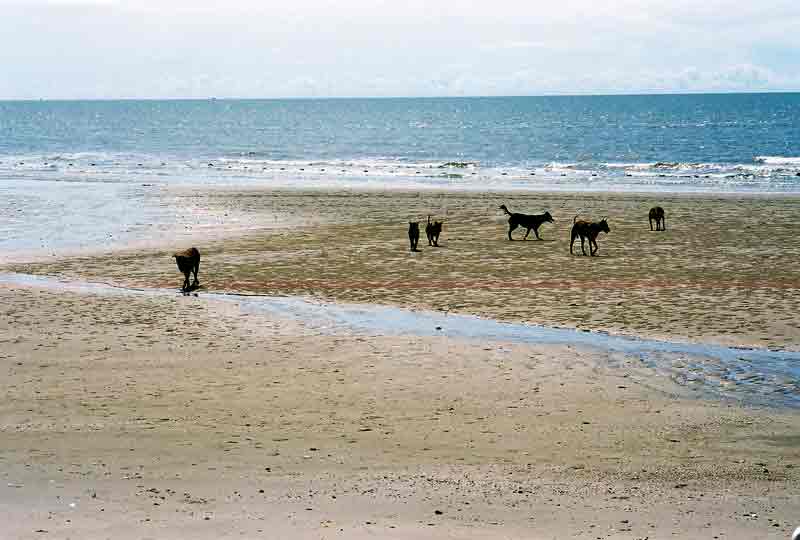
On both our trips I have been fascinated by Thailand dogs. Some of them seem so smart and tough. I love watching them. Here is a link to a picture of a dog that we met in Cha Am. He just sat with our family as we ate. When we gave him some leftovers he buried it, maybe not up to his standards. His expression is so calm. Here is another picture of a pack of dogs in Cha Am.
A funny and interesting blog.
On both our trips I have been fascinated by Thailand dogs. Some of them seem so smart and tough. I love watching them. Here is a link to a picture of a dog that we met in Cha Am. He just sat with our family as we ate. When we gave him some leftovers he buried it, maybe not up to his standards. His expression is so calm. Here is another picture of a pack of dogs in Cha Am.

Globalization
Last year, when returning from Thailand, we had a twelve hour lay over in Korea. At the bookstore I bought a copy of The Lexus and the Olive Tree: Understanding Globalization by Thomas Freidman. It was not a boring book. Technology education and adoption is being driven by global economic change. Having some understanding of globalization helps to see the broader implications of the pressure to use technology. I have ordered The World Is Flat: A Brief History of the Twenty-first Century as a continuation of exploring globalization. I also read the Wall Street Journal on a daily basis and Business Week. Both publications are actually fascinating. I especially look forward to reading Business Week. I find that having at least a superficial knowledge of business trends is helpful when I read the Bangkok Post and The Nation web sites each day. Business, economics, and globalization are at the core of the pressure for technology adoption and training. The economic effects of globalization can radically change individual lives.
Wednesday, July 20, 2005
Fairbanks Thai Restaurants published on 2Bangkok,com
2Bangkok.com - Almost like being there: "New Thai Restaurants in Fairbanks Alaska - July 18, 2005
Good News, my Thai Restaurant photographs were published on 2Bangkok.com. Here is the quote.
Stephen Cysewski writes: I just put up a web page on the Thai Restaurants in Fairbanks Alaska. I thought it might be interesting to the 2Bangkok.com community.
Fairbanks Alaska is the second largest city in Alaska, the total population in the area is around 80,000. Fairbanks has nine Thai restaurants. The Thai House was the first and the new restaurant being, opened by the owners of Bahn Thai, is the newest. So far all the restaurants are successful. It is kind of amazing that Fairbanks can support so many Thai restaurants."
Good News, my Thai Restaurant photographs were published on 2Bangkok.com. Here is the quote.
Stephen Cysewski writes: I just put up a web page on the Thai Restaurants in Fairbanks Alaska. I thought it might be interesting to the 2Bangkok.com community.
Fairbanks Alaska is the second largest city in Alaska, the total population in the area is around 80,000. Fairbanks has nine Thai restaurants. The Thai House was the first and the new restaurant being, opened by the owners of Bahn Thai, is the newest. So far all the restaurants are successful. It is kind of amazing that Fairbanks can support so many Thai restaurants."
Subscribe to:
Posts (Atom)